Ovarian Cancer Risk Factors: Age, Genetics, and Lifestyle
If you have landed on this page, you may be carrying a quiet worry. Maybe a relative was diagnosed. Maybe you read something online, and now you are wondering, Could this be me? That worry is real, and you deserve clear, honest answers, not scary headlines or confusing medical jargon.
Here is the real talk: having a risk factor does not mean you will get ovarian cancer. And having none does not mean you are in the clear. Risk factors are simply clues about what makes ovarian cancer a little more or a little less likely. Understanding them helps you and your doctor make smart choices together.
This guide walks through the main ovarian cancer risk factors, age, genetics, family history, and lifestyle, in plain language. We will also be honest about what we still do not know, and about why some women, especially Black women, face higher stakes and deserve better access to care.
Key takeaways
- A woman's lifetime risk of getting ovarian cancer is about 1 in 91, according to the American Cancer Society. That is roughly a 1 percent chance over a lifetime, and well under 2 percent for most women.
- Age is the biggest single risk factor. Ovarian cancer is rare before age 40. Most cases develop after menopause, and about half of women diagnosed are 63 or older.
- Inherited gene changes like BRCA1, BRCA2, and Lynch syndrome carry the strongest known increase in risk. A family history of ovarian, breast, or colorectal cancer is an important clue.
- Some lifestyle and reproductive factors nudge risk up or down, but they are far weaker than genetics and age.
- There is no reliable routine screening test for ovarian cancer in women at average risk, which is why knowing your risk and your body matters.
- Black women are more likely to die from ovarian cancer, largely because of disparities in diagnosis and access to care, not because of anything they did wrong.
A note before we begin: This article is for education and support. It is not a substitute for advice from your own doctor or genetic counselor, who knows your full history.
What "risk factor" actually means
A risk factor is anything that changes your chances of getting a disease. Some you can change, like whether you smoke. Many you cannot, like your age or the genes you were born with.
A few things to hold onto:
- Risk factors are about probability, not destiny. Many women with several risk factors never develop ovarian cancer. Some women with none still do.
- Risk factors add up and interact in ways researchers are still untangling.
- Knowing your risk is powerful, because it helps you and your clinician decide what to watch for and whether extra steps, like genetic counseling, make sense for you.
Ovarian cancer risk factors you cannot change
Age
Age is the strongest and most consistent risk factor. Ovarian cancer is rare in women younger than 40. Most cases develop after menopause, and about half of women diagnosed are 63 or older, according to the American Cancer Society.
This does not mean younger women are immune. Certain types of ovarian cancer, and cases tied to inherited gene changes, can appear earlier. But in general, the risk climbs as you get older.
Genetics and inherited gene changes
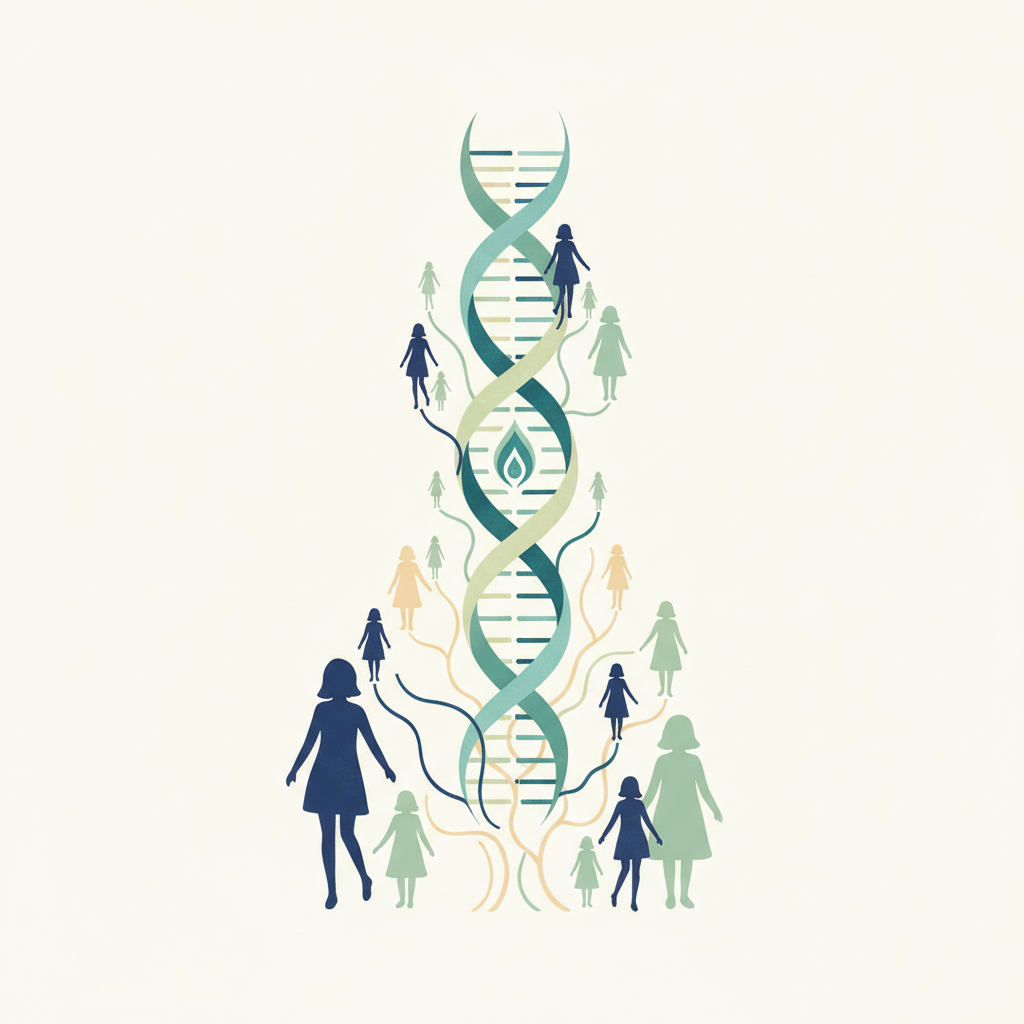
Inherited gene changes are responsible for a meaningful share of ovarian cancers, and they carry the largest known jump in risk. The most important ones:
- BRCA1 and BRCA2. These genes normally help repair damaged DNA. When a person inherits a harmful change in one of them, that protection is weakened. The American Cancer Society estimates the lifetime ovarian cancer risk is about 35 to 70 percent for women with a BRCA1 change and about 10 to 30 percent (by age 70) for women with a BRCA2 change, far above the roughly 1 percent baseline for women in general. BRCA changes also raise breast cancer risk.
- Lynch syndrome (also called hereditary non-polyposis colorectal cancer). This inherited condition raises the risk of ovarian, colorectal, uterine, and other cancers.
- Other genes, including BRIP1, RAD51C, RAD51D, and PALB2, are linked to smaller increases in risk. Genetic testing has gotten much better at finding them.
BRCA changes are not evenly distributed. They are about 10 times more common among people of Ashkenazi Jewish heritage than in the general U.S. population. Other communities carry their own founder changes, which is one reason culturally informed genetic counseling matters.
If inherited risk runs in your family, a genetic counselor can help you decide whether testing makes sense and what the results would mean. This is not about fear. It is about information and options.
Family and personal health history
Even without a known gene change, your family tree tells a story. Your risk is higher if you have close relatives, on either your mother's or your father's side, with:
- Ovarian cancer
- Breast cancer, especially at a young age
- Colorectal or uterine cancer (which can point to Lynch syndrome)
A personal history of breast, uterine, or colorectal cancer can also raise ovarian cancer risk. So can endometriosis, a condition where tissue similar to the lining of the uterus grows outside the uterus.
Reproductive and hormonal history
Several factors tied to your reproductive life can shift risk:
- Never having been pregnant is associated with somewhat higher risk.
- Starting your period early or going through menopause late is associated with slightly higher risk, likely because of more lifetime ovulation cycles.
These factors are real but modest. They are pieces of the puzzle, not the whole picture.
Lifestyle and other factors
People often hope there is a simple lifestyle switch that controls ovarian cancer risk. The honest answer is that lifestyle plays a smaller role here than it does for some other cancers. Still, a few things are worth knowing.
Factors that may raise risk
- Excess body weight. A higher body weight has been linked to a modestly higher risk of ovarian cancer in some studies, and it can affect outcomes too.
- Certain hormone therapies after menopause. Some research links long-term use of estrogen-only hormone replacement therapy to a higher risk. If you are weighing hormone therapy for menopause symptoms, this is a good conversation to have with your clinician about your personal balance of benefits and risks.
- Smoking is linked to a specific subtype of ovarian cancer (mucinous), and it harms health in many other ways.
You may have seen headlines about talcum (talc) powder in the genital area. The evidence has been mixed and is still debated by researchers and major health agencies. If avoiding it gives you peace of mind, that is a reasonable personal choice, but the science is not settled.
Factors that may lower risk
It is not all about what raises risk. Some experiences are linked to lower ovarian cancer risk:
- Pregnancy and breastfeeding are associated with lower risk, and longer breastfeeding has been tied to lower risk still.
- Oral contraceptives (birth control pills). Women who used them for five or more years have about a 50 percent lower risk of ovarian cancer, according to the American Cancer Society. The protection appears to last for years after stopping. Birth control pills carry their own risks and benefits, so this is a personal decision to make with a clinician, not a reason to take them just for cancer prevention.
- Tubal ligation (having your tubes tied) and removal of the ovaries or fallopian tubes are linked to lower risk.
The takeaway is balance: protective factors are real, but no single choice guarantees protection.
Why there is no simple screening test
One of the hardest truths about ovarian cancer is this: for women at average risk, there is no reliable routine screening test that catches it early and saves lives. Tests like the CA-125 blood test and transvaginal ultrasound are not accurate enough for general screening. They miss some cancers and raise false alarms in healthy women, which can lead to unnecessary surgery. For this reason, major bodies, including the U.S. Preventive Services Task Force, recommend against routine ovarian cancer screening in women at average risk who have no symptoms.
This matters because the early symptoms, like bloating, feeling full quickly, pelvic or belly pain, and needing to urinate often, are vague and easy to brush off. As a result, many ovarian cancers are found at a later stage, when they are harder to treat.
That is exactly why knowing your risk and knowing your body is so important. It is not about living in fear. It is about noticing when something feels off and not waiting to speak up.
Risk, race, and the disparities we cannot ignore
Risk is not only biological. It is also shaped by access, trust, and how the health system treats different women.
Research consistently shows that Black women are more likely to die from ovarian cancer and tend to have lower five-year survival than white women, even though their overall incidence is somewhat lower. Studies point to later-stage diagnosis and unequal access to high-quality, timely care as major drivers, alongside socioeconomic and systemic factors. Notably, when Black and white women receive similar, guideline-based treatment, the survival gap narrows sharply, a strong sign that access, not biology, is doing much of the harm.
Let us be clear: this is not about anything Black women, or any women historically left out of the conversation, did wrong. It is about a system that has not served everyone equally. Closing that gap, through education, early detection, and equitable access to care, is at the heart of why HopeCare Global exists.
What you can do with this information
You do not have to manage this alone, and you do not have to figure it out overnight. A few gentle, practical steps:
- Learn your family history. Ask relatives about cancers on both sides of the family, especially ovarian, breast, uterine, and colorectal cancer.
- Share that history with a clinician. It helps them decide whether genetic counseling or closer monitoring makes sense for you.
- Know the symptoms, and pay attention to changes that are new for you and that last more than a couple of weeks. Trust yourself, and ask for follow-up if something feels wrong.
- Ask questions, and seek a second opinion if you feel unheard. You deserve a care team that listens.
- Find community and support. Facing risk, or a diagnosis, is easier with people who understand.
How HopeCare Global walks with you
At HopeCare Global, we believe every woman deserves to understand her body, her risk, and her options, in language that respects her culture, her faith, and her family. Our work centers on early detection through symptom literacy and screening pathways, plain-language education that breaks stigma, patient navigation that helps families find financial aid and support, and global, diaspora-led outreach so no one is left out of the conversation.
If this article raised questions, that is a good thing. The next step is a conversation, with a trusted clinician, a genetic counselor, or our community. You are not alone in this, and knowledge is a form of hope.
Medical disclaimer
This article is provided by HopeCare Global Inc for educational and informational purposes only. It is not medical advice, and it is not a substitute for diagnosis, treatment, or guidance from a qualified healthcare professional who knows your individual history. Statistics and risk estimates vary by source and over time, and the science continues to evolve. Always talk with your doctor or a genetic counselor about your personal risk and any decisions about screening, testing, or care. If you are experiencing concerning symptoms, please contact a healthcare provider.
Sources
- American Cancer Society, About half of women diagnosed with ovarian cancer are 63 or older; it is rare before 40. BRCA1 lifetime ovarian cancer risk ~35-70%; BRCA2 ~10-30% by age 70. BRCA changes are about 10x more common in Ashkenazi Jewish people. BRIP1, RAD51C, RAD51D, PALB2 also linked. Endometriosis, never being pregnant, early menstruation, late menopause raise risk. Oral contraceptive use of 5+ years is linked to about 50% lower risk; pregnancy/breastfeeding, tubal ligation, and removal of ovaries/tubes lower risk.
- American Cancer Society, A woman's lifetime risk of getting ovarian cancer is about 1 in 91, and lifetime risk of dying from it is about 1 in 143; about 21,010 new cases and 12,450 deaths estimated for 2026; about half of women diagnosed are 63 or older.
- National Cancer Institute, BRCA1/BRCA2 and Lynch syndrome and DNA repair; ovarian cancer symptoms; limitations of CA-125 and transvaginal ultrasound; no reliable routine screening for average-risk women.
- American College of Obstetricians and Gynecologists (ACOG), Genetic counseling and testing for inherited cancer risk (BRCA1/BRCA2, Lynch syndrome) and risk assessment for hereditary ovarian and breast cancer.
- American Cancer Society, Talcum (talc) powder and ovarian cancer: study findings are mixed; some studies report a slightly increased risk and some report no increase; the link is not settled.
- U.S. Preventive Services Task Force (USPSTF), Routine screening for ovarian cancer (including CA-125 and transvaginal ultrasound) is not recommended for average-risk, asymptomatic women; screening does not reduce ovarian cancer deaths and causes harms such as false positives and unnecessary surgery (Grade D recommendation).
- PMC / peer-reviewed (Race, Socioeconomic Status, and Health-Care Access Disparities in Ovarian Cancer Treatment and Mortality: Systematic Review and Meta-Analysis), Black women are more likely to die from ovarian cancer and have lower five-year survival than white women despite somewhat lower incidence, driven by later-stage diagnosis and disparities in access to quality, timely care; survival gaps narrow when treatment is guideline-adherent.
- Centers for Disease Control and Prevention (CDC), Ovarian cancer statistics, risk factors, symptom awareness, and lack of recommended routine screening for average-risk women.